Renting a Space for a Holiday Cookie Decorating Party or Cookie Exchange: Kitchens, Long Tables & Easy Cleanup
November 2026 · 10 min read
Short answer
If the cookies are baked ahead, rent an event room, studio or meeting room with long tables, bright light, a sink nearby and a host who allows outside food. If you want to bake on site, rent a kitchen and confirm the oven count, the pans and the cooling space in writing. Either way, ask about table covers, cleanup terms and the end time before you pay, and book extra time at the end for icing to set and for the sprinkles on the floor.
A cookie decorating party is one of the easiest holiday gatherings to plan and one of the hardest to host in a small apartment. It needs a lot of flat surface, it is messy in a way dinner is not, and it usually involves more guests than fit around anyone's kitchen table. A cookie exchange has a similar problem: twenty people each bringing a few dozen cookies need somewhere to set them all out. Renting a room for a few hours fixes the space problem and keeps the powdered sugar out of your own couch.
This guide covers which spaces work for decorating parties, bake-and-decorate days and cookie swaps, how to think about table and kitchen space, the food-safety and allergy points worth planning around, how long to book, and what to ask the host. If the cookies are one part of a bigger celebration, our guide to renting a space for a holiday party covers the rest of the evening.
Pick the format first
The format decides the space. The biggest question is whether anything gets baked on site. If it does, you need a kitchen. If it does not, the list of rooms that will work gets much longer and usually cheaper.
Decorating party (cookies baked ahead)
The host or a baker brings plain cut-out cookies and icing. Guests sit at tables and decorate. No oven needed, so almost any room with tables, a sink nearby and food allowed will work.
Bake-and-decorate day
Dough is rolled, cut and baked on site, then decorated once the cookies cool. You need a kitchen, oven capacity for the batches you plan, counter space for rolling and a place for trays to cool.
Cookie exchange or swap
Each guest bakes at home and brings a set number of cookies to trade. The room needs one long display table, a place for coats and containers, and enough table space for people to pack their take-home boxes.
Kids' decorating party
Shorter sessions, lower tables or booster seats, smocks, and far more sprinkles on the floor. A room with hard floors and a sink in the same space makes the end of the party much easier.
Many hosts combine formats: guests bring a batch to swap and spend the first hour decorating a set of plain cookies the host baked the day before. That works well, and it still does not need an oven.
Spaces that work for cookie parties
Rentable home or commercial kitchen
The only real choice if you plan to bake on site. Ask how many ovens, racks and sheet pans come with it.
How kitchen rentals workEvent room or community-style hall
Long folding tables and wipeable floors. Best for a big decorating party with cookies baked ahead.
Event spacesOffice or meeting room
A clean conference table, a sink down the hall and a fixed end time. Good for a team cookie swap.
Office and meeting roomsCraft or art studio
Built for messy tables, aprons and kids. Ask whether food is allowed in the same room as the art supplies.
Craft workshop spacesA home with a large kitchen island can also work for a small group, as long as the host is comfortable with guests using the kitchen. For anything with children or more than a dozen people, a room with hard floors and a sink close by is worth more than nice decor. Icing and sprinkles end up everywhere, and carpet makes the end of the party much slower.
Table and counter math
Guest count alone will mislead you. A table that seats eight for dinner may only fit five or six people decorating, because each person needs room for a plate of cookies, icing bags or bowls and a few toppings, and the middle of the table fills up with shared sprinkles. Plan around these surfaces:
- Decorating tables: one seat per guest with elbow room, plus shared space down the middle for toppings.
- A drying table: decorated cookies need somewhere flat to sit while icing sets before they are stacked or boxed.
- A swap table: for an exchange, one long table where every batch is laid out with a label.
- A packing area: space for guests to fill take-home boxes, tins or bags without crowding the decorators.
- A drinks and snack table: kept separate so cups are not knocked into the icing.
- Counters, if baking: room to roll and cut dough, plus somewhere for hot trays to cool safely.
Ask the host for the number and size of tables included, not just the room's capacity. A room listed for 40 standing guests can have only a few tables on site, and you may need to bring folding tables or rent them.
If you plan to bake on site
Baking at a rented space is the part most likely to go wrong, usually because the renter assumes kitchen access comes with the room. Confirm each of these before you book:
- Kitchen use is included. A listing that mentions a kitchen may mean a counter and a sink, not an oven you can use.
- Oven capacity. How many ovens, how many racks, and roughly how many trays fit at once. Oven capacity sets the pace of the whole day.
- Equipment. Sheet pans, cooling racks, mixing bowls, a stand mixer or rolling pins. If the host has none, bring your own and label them.
- Fridge space for chilling dough, butter, eggs and any icing made with dairy.
- Who cleans the kitchen and to what standard. Kitchens are where cleaning fees and deposit disputes start.
A practical shortcut is to make and chill the dough at home, then only roll, bake and decorate at the venue. That cuts the time you need in the kitchen and the number of things that can go wrong there.
Food safety and allergies
Two food-safety points come up at almost every cookie party. The first is raw dough. The CDC says most flour is raw, meaning it has not been treated to kill germs such as E. coli and Salmonella, and that raw eggs can carry Salmonella. Its advice is not to eat raw dough or batter, not to let children play with or eat dough made with raw flour (including craft dough), and to wash hands, bowls, utensils and counters after handling flour, eggs or raw dough. At a party where kids are cutting shapes, that means telling everyone up front that dough gets baked before anyone eats it, and keeping a hand-washing spot close by.
If guests will want to snack on dough, the CDC points to store-bought edible cookie dough made with heat-treated flour and pasteurized or no eggs, labeled as safe to eat without baking. Icing recipes that use raw egg whites are another place to choose pasteurized egg whites or a meringue powder instead; the FDA recommends pasteurized eggs or egg products for recipes that call for raw or undercooked eggs.
The second point is allergens. The FDA lists nine major food allergens: milk, eggs, fish, crustacean shellfish, tree nuts, peanuts, wheat, soybeans and sesame. Cookie exchanges in particular mix many home kitchens on one table. Ask each guest to bring a small card listing the main ingredients and any of the major allergens, keep anything with nuts on its own plate with its own tongs, and say in the invitation how you are handling it so guests with allergies can decide what to bring and what to take home.
Looking for a room for your cookie party?
Send a request with your city and state, how far your group is willing to travel, your date and hours, how many guests are coming, and whether you need an oven or just tables and a sink.
Request a SpaceHow long to book
Cookie parties take longer than they look on the invitation. Build the booking block from these pieces:
- Setup: covering tables, laying out cookies and icing, setting up the swap and drinks tables.
- Arrivals: guests rarely arrive at once, and swap batches need to be unpacked and labeled.
- Baking, if any: batches go in one tray set at a time, and cookies need to cool before icing goes on.
- Decorating: the main event. Kids tend to finish fast; adults working on detailed icing take much longer.
- Setting time: icing needs time to firm up before cookies can be stacked or boxed without smudging.
- Packing and cleanup: boxing cookies, wiping tables, sweeping sprinkles and taking out trash.
If you are unsure, book the longer block. Hosts with back-to-back bookings may not be able to give you extra time, and the last half hour is when everyone is packing cookies and the room is at its messiest.
Running a cookie exchange
A cookie exchange works best with a few simple rules sent out with the invitation: how many cookies each person brings, whether they should be homemade, how they should be packaged, and how the swap works on the day. Common approaches are to have each guest bring enough for everyone to take a few, or to bring a fixed number and leave with the same number of mixed cookies. Ask guests to bring their own container to take cookies home in, and keep a stack of spares for anyone who forgets.
In the space itself, the swap table is the centerpiece. Give it the best light in the room if you plan to take photos, label every batch with the baker's name and its ingredient card, and keep the drinks well away from it. For a workplace swap in a meeting room, check whether the building has rules about food in shared areas and whether there is a fridge you can use for anything that needs to stay cold.
Questions to ask the host before you book
- Is outside food allowed, and can guests bring homemade baked goods to share or trade?
- If there is a kitchen: how many ovens and racks, and are sheet pans, cooling racks and mixing bowls included?
- Is there a sink in the room, or only down the hall? Is there a fridge for icing and dairy?
- Can we cover tables with our own plastic or paper covers, and are tape and table runners allowed?
- What cleaning is expected of us, and is there a cleaning fee or a deposit tied to cleanup?
- Where does trash go, and do you have recycling or compost for paper plates and boxes?
- Is the floor carpet or hard surface? (Sprinkles and powdered sugar matter here.)
- Are children allowed, and is there a guest limit or a limit on alcohol if we serve mulled wine or eggnog?
- When can we start setting up, and how firm is the end time?
Get the answers in the booking messages, not just on a call. If the host says the oven is fine to use or that a light wipe-down is all the cleaning required, having that in writing protects your deposit later.
What to bring
- Plastic or paper table covers and painter's tape to hold them down.
- Paper towels, wet wipes, trash bags and a small broom or hand vacuum.
- Small bowls or muffin tins for sprinkles, so toppings stay off the table.
- Piping bags, tips, offset spatulas or butter knives, and toothpicks for detail work.
- Labels and pens for the swap table and for guests' take-home boxes.
- Boxes, tins or bags for anyone who forgets a container.
- Aprons or old t-shirts for kids, and a change of clothes if they are young.
- An extension cord if you plan to run a stand mixer or a slow cooker for warm drinks.
Common mistakes
- Assuming a room with a kitchen means you can use the oven.
- Booking by guest count without asking how many tables come with the room.
- Forgetting the time icing needs to set before cookies can be packed.
- Not asking about cleanup until the last half hour of the booking.
- Letting kids eat raw dough while they cut shapes.
- Leaving allergens unlabeled on a shared swap table.
Before you pay: a short checklist
- Kitchen and oven use confirmed in writing, if you are baking.
- Table count, chair count, sink access and floor type confirmed.
- Outside food, kids, alcohol and end-time rules confirmed in the booking messages.
- Booking block includes setup, decorating, icing set time and cleanup.
- Parking and entry instructions sent to every guest, along with the swap rules.
- Payment, deposit, cleaning fee and cancellation terms read. Our first-time renter's guide covers how to book safely.
Find a space for your cookie decorating party
Tell us your city and state, how far your guests will travel, the date and hours, the guest count and whether you need a kitchen. Have a kitchen or a room with long tables? You can list it for holiday baking groups too.
Frequently asked questions
What kind of space do I need for a cookie decorating party?
If the cookies are baked ahead, you mainly need tables, chairs, good overhead light, a sink nearby and a host who allows outside food. If you want to bake on site, you need a rentable kitchen with enough oven space for your batches and counter room for rolling dough and cooling trays.
How much table space does each guest need to decorate cookies?
Plan for each person to have room for a plate of cookies, a few icing bags or bowls and a small tray of toppings, plus shared space in the middle of the table for sprinkles and spare icing. Guests packed elbow to elbow get frustrated quickly, so seat fewer people per table than you would for dinner.
Can I bake cookies at a rented space?
Only if the listing includes kitchen use and the host confirms it in writing. A room listed for events does not automatically include the oven. Ask how many ovens and racks there are, how long they take to heat, and whether pans and cooling racks are included.
Is it safe to let guests taste raw cookie dough?
No. The CDC advises against eating raw dough or batter made with regular flour or raw eggs, because flour and raw eggs can carry germs such as E. coli and Salmonella. That includes dough used for crafts. Bake it first, or buy dough labeled as safe to eat raw.
How should I handle food allergies at a cookie exchange?
Ask guests to label each batch with the main ingredients and common allergens such as peanuts, tree nuts, milk, eggs, wheat, soy and sesame. Keep nut-containing cookies on their own plate with their own tongs, and tell guests in the invitation so anyone with an allergy can plan.
How long should I book a space for a cookie decorating party?
Book enough time for setup, the decorating itself, a break for snacks, letting icing set before people pack cookies to take home, and a real cleanup. A bake-and-decorate day needs much longer than a decorating-only party because of baking and cooling time between batches.
What should I ask the host about cleanup?
Ask exactly what condition the room must be left in, whether there is a cleaning fee, whether any deposit depends on cleanup, and where trash goes. Bring your own table covers, paper towels and a broom or vacuum if the host does not supply one, and photograph the room when you arrive and when you leave.
Sources
- CDC: Raw Flour and Dough (Food Safety)
- FDA: What You Need to Know About Egg Safety
- FDA: Food Allergies (the nine major food allergens)
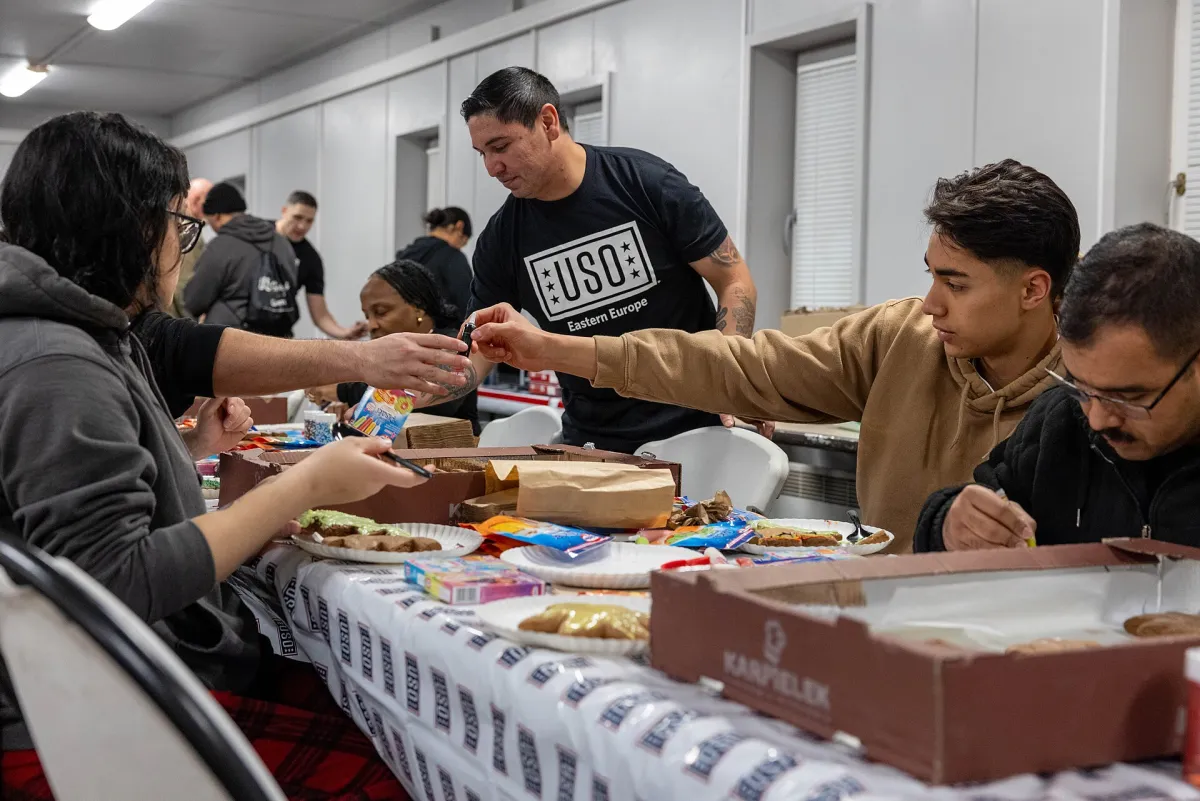
- Hero photo: U.S. Soldiers decorate gingerbread cookies at a USO Christmas event in Adazi, Latvia, Dec. 2, 2025, by Pfc. Gabriel Martinez, U.S. Army (Wikimedia Commons, public domain)
This guide is general planning information, not food-safety or medical advice. Follow the host's house rules, guest limits and any local rules that apply to your event.